

EMRS Staff Nurse Document Verification Checklist Essential Papers for Hiring Success
Updated: Oct 16
A strong exam score or interview performance can move a staff nurse closer to selection, but document verification is where eligibility becomes official. For EMRS staff nurse hiring, the verification stage confirms that the candidate has the right qualifications, valid nursing registration, relevant experience, and a clean record for work in a residential school setting.
Missing papers, name mismatches, expired registration, unclear photocopies, or unsupported claims can delay the process. In some cases, they can also lead to rejection. A well-prepared document file helps the verification team check details quickly and gives candidates confidence on the day of reporting.
This guide explains the essential EMRS document verification list for staff nurse candidates, why each document matters, and how to prepare everything efficiently.

Why document verification matters in EMRS staff nurse hiring
Document verification is not a formality. It protects the integrity of the recruitment process and confirms that the selected candidate can safely take up the role.
For a staff nurse post, this check carries extra weight because the role involves student health, emergency response, medicine records, first aid support, and coordination with hospitals or guardians when needed. EMRS institutions are residential schools, so the nurse may be part of the daily safety system for children and adolescents.
Verification usually checks four broad areas.
Verification area | What it confirms | Why it matters |
Identity | The candidate is the same person who applied | Prevents impersonation and record errors |
Qualification | The candidate completed the required nursing course | Confirms academic eligibility |
Registration | The candidate is legally registered to practise nursing | Supports safe and lawful hiring |
Conduct and experience | The candidate’s work record and background are suitable | Helps assess reliability and fit |
The exact checklist may vary by recruitment notice, state rules, and the authority handling the process. Candidates should always read the latest official notification and call letter carefully. Still, the documents below are commonly needed for staff nurse verification.
Core documents every staff nurse candidate should prepare
A good verification file starts with the documents that prove identity, eligibility, and professional standing. Keep originals ready and carry self-attested photocopies unless the instructions say otherwise.
Valid nursing licence or registration certificate
The nursing registration certificate is one of the most critical documents for a staff nurse post. It proves that the candidate is registered with the relevant State Nursing Council or a recognised nursing registration body.
This document may also be called a nursing licence, registration certificate, or renewal certificate, depending on the state and issuing council.
The verification team may check:
Candidate name
Registration number
Date of registration
Validity or renewal status
Nursing qualification linked to the registration
Issuing council name and seal
A valid registration shows that the candidate has met the professional requirements to practise nursing. It also helps the hiring authority confirm that the person is not only academically qualified but also professionally recognised.
If the registration has expired or renewal is pending, it can create problems. Candidates should renew it well before verification, as council processing times can vary.
Preparation tip: Keep the original registration certificate, renewal receipt if applicable, and a clear photocopy in the same section of the file. If the certificate contains an old name after marriage or any legal name change, carry proof of the name change.
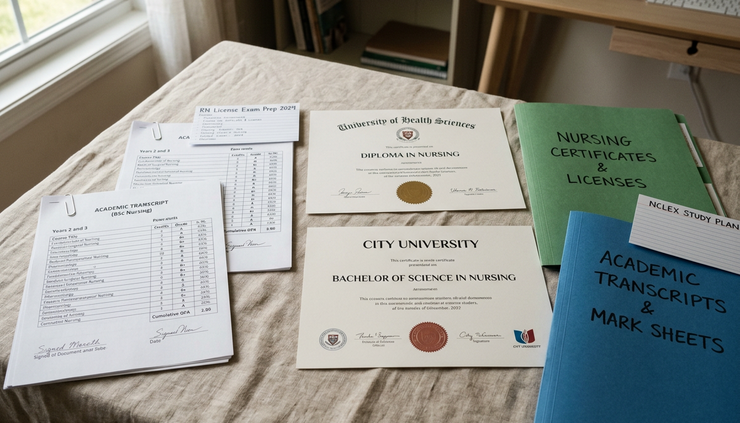
Educational qualification certificates
Educational documents prove that the candidate has completed the course required for the staff nurse post. For nursing roles, this usually includes certificates and mark sheets for GNM, B.Sc. Nursing, or another recognised nursing qualification mentioned in the recruitment notice.
A standard education file may include:
Class 10 certificate or mark sheet for date of birth proof
Class 12 certificate or mark sheet, if required
Nursing diploma or degree certificate
Year-wise or semester-wise mark sheets
Internship or clinical training completion certificate, if issued separately
Certificate from a recognised institution or university
Equivalence certificate, if applicable
These papers help the verification team confirm that the course, institution, and completion date match the eligibility conditions.
They also help check whether the candidate had completed the qualification before the cut-off date mentioned in the recruitment notice. If results were declared after the cut-off date, the candidate may not meet eligibility, even if the degree is now complete.
Preparation tip: Arrange academic papers in chronological order, from Class 10 to the latest nursing qualification. This makes it easier for the verification officer to trace the education path without searching through the entire file.
Work experience certificates
Work experience may be required or preferred depending on the recruitment conditions. Even where experience is not compulsory, it can support the candidate’s profile during appointment and posting formalities.
Experience certificates should come from authorised officials of the hospital, clinic, school health unit, community health centre, nursing home, or healthcare organisation where the candidate worked.
A useful experience certificate should clearly mention:
Candidate name
Designation held
Department or unit, if relevant
Employment start date and end date
Nature of duties
Full-time, part-time, contractual, or regular status
Organisation name and address
Signature, name, designation, and seal of the issuing authority
Experience documents help the hiring authority understand whether the candidate has handled duties similar to the EMRS staff nurse role. For example, work in paediatrics, emergency care, residential health settings, school health programmes, or general wards can show practical exposure.
Do not submit vague certificates that only say the candidate “worked here” without dates or role details. Such certificates may be questioned.
Preparation tip: Ask previous employers for a detailed certificate early. If the organisation has closed or changed management, collect any supporting proof available, such as appointment letters, relieving letters, salary slips, or identity cards, if the notification allows supporting documents.
Background checks and character documents
Background verification helps the employer assess trustworthiness and suitability for a residential educational environment. Since staff nurses may work around minors and handle sensitive health information, conduct and background checks matter.
The documents required can vary, but candidates may be asked for:
Police verification certificate
Character certificate from a recognised authority
Declaration of no criminal case, if prescribed
Court case disclosure, if applicable
Previous employer conduct certificate
Medical fitness certificate
A clean background record supports safe hiring. If a candidate has any pending case or past disciplinary issue, it should be disclosed as required in the application and verification forms. Non-disclosure can become more serious than the issue itself.
Character certificates are usually expected to be recent and issued by a competent authority. Candidates should check whether the recruitment instructions mention who can issue them.
Preparation tip: Apply early for police verification if it is required, as timelines can differ across districts. Keep both the original and photocopy, and make sure the name and address match the application form.
Identity, category, and personal records
Along with professional papers, staff nurse candidates should organise personal records that support identity, age, address, and reservation benefits.
Proof of identity and date of birth
Commonly accepted identity documents include Aadhaar card, PAN card, passport, voter ID, or driving licence. The exact accepted list will come from the recruitment instructions.
Date of birth is often verified through the Class 10 certificate or birth certificate. The date must match the application form. Even a small mismatch can delay verification.
Carry:
Original photo ID
Photocopy of photo ID
Class 10 certificate or mark sheet
Recent passport-size photographs
Copy of the application form
Admit card or call letter for verification
Preparation tip: Use the same spelling of your name across all documents wherever possible. If there are differences, carry an affidavit or gazette notification, depending on the nature of the change.
Category and reservation certificates
Candidates claiming reservation or relaxation must carry valid certificates in the prescribed format. This may include SC, ST, OBC, EWS, PwBD, ex-servicemen, or other applicable certificates.
For OBC and EWS, validity and format are especially important. Certificates may need to be recent and issued by the correct authority. PwBD candidates may need a disability certificate from a competent medical board.
These documents matter because reservation benefits, age relaxation, fee relaxation, or special consideration depend on them. If the certificate is invalid or in the wrong format, the benefit may not be allowed.
Preparation tip: Compare the certificate format with the one mentioned in the recruitment notice. A certificate issued for another scheme may not always be accepted for recruitment.

How each document supports the hiring decision
Each paper in the verification file answers a specific question for the hiring authority.
The nursing licence answers whether the candidate is registered and eligible to practise. Educational certificates answer whether the candidate has completed the required nursing course from a recognised institution. Experience certificates answer whether the candidate has relevant practical exposure. Background documents answer whether the candidate is suitable for a role involving care, safety, and close contact with students.
Together, these documents reduce hiring risk. They also protect genuine candidates. A transparent verification process helps ensure that the final appointment goes to someone who meets the same eligibility standards as every other selected candidate.
For staff nurses, document verification also supports future administrative work. The same records may be needed for joining, service book creation, salary processing, posting, and employee identity documents.
Practical checklist for EMRS staff nurse document verification
Use this checklist to prepare the file before the verification date. The final list from the official notice should always take priority.
Document | Original | Photocopy | Self-attested | Checked |
Application form | Yes | Yes | ||
Admit card or verification call letter | Yes | Yes | Yes | |
Photo identity proof | Yes | Yes | Yes | |
Class 10 certificate for date of birth | Yes | Yes | Yes | |
Class 12 certificate, if required | Yes | Yes | Yes | |
Nursing diploma or degree certificate | Yes | Yes | Yes | |
Nursing mark sheets | Yes | Yes | Yes | |
Nursing registration certificate | Yes | Yes | Yes | |
Registration renewal proof, if applicable | Yes | Yes | Yes | |
Internship or clinical training certificate | Yes | Yes | Yes | |
Work experience certificates | Yes | Yes | Yes | |
Appointment or relieving letters, if needed | Yes | Yes | Yes | |
Category certificate, if applicable | Yes | Yes | Yes | |
PwBD certificate, if applicable | Yes | Yes | Yes | |
Police verification or character certificate | Yes | Yes | Yes | |
Medical fitness certificate, if asked | Yes | Yes | Yes | |
Passport-size photographs | Originals | |||
Name change proof, if applicable | Yes | Yes | Yes |
This table is a working checklist, not a substitute for the official instructions. Some recruitments may ask for extra forms, declarations, or documents at the time of joining.
Common issues that can delay verification
Most verification problems are avoidable. The same issues appear often because candidates prepare documents at the last minute.
Name mismatch across documents
A common issue is variation in name spelling, initials, surname order, or name after marriage. For example, the application may carry a full name, while the nursing registration certificate may use initials.
If the difference is minor, an affidavit may help. If the change is legal, a gazette notification or marriage certificate may be required. The safest approach is to carry all supporting documents and explain the sequence clearly.
Expired nursing registration
Some councils require periodic renewal. An expired registration may raise questions about current eligibility to practise. Start the renewal process as early as possible.
If renewal is under process, carry proof of application, payment receipt, and any acknowledgement from the council. Acceptance depends on the rules given by the recruitment authority.
Incomplete experience certificate
Experience certificates without dates, designation, seal, or authorised signature can be treated as weak proof. Candidates should request the employer to issue a complete certificate on letterhead.
Unclear photocopies
Blurred photocopies, cropped seals, or grey text can slow the process. Use clean copies on A4 paper. Avoid reducing the size of certificates too much.
Wrong certificate format
Reservation and category certificates must match the required format. A certificate that is valid for education admission may not be valid for government recruitment. Always check the wording and issuing authority.
Tips to prepare documents efficiently
A calm verification day begins with a well-arranged file. The goal is simple: any document requested should be available within seconds.
Create a master folder
Use a sturdy file with transparent sleeves or clearly labelled sections. Keep originals separate from photocopies to avoid mixing them.
A practical order is:
Call letter and application form
Identity and date of birth proof
Educational certificates
Nursing registration documents
Experience certificates
Category or special claim certificates
Background and character documents
Photographs and extra declarations
Place a printed checklist at the front and tick each item after adding it.
Keep multiple photocopy sets
Carry at least two or three sets of photocopies if the instructions do not specify a number. Self-attest each copy if required. Sign in blue or black ink as directed.
Do not self-attest originals. Sign only photocopies.
Scan documents in advance
Keep scanned copies on a pen drive and in secure cloud storage. Use clear file names such as `GNM_Final_Certificate`, `Nursing_Registration`, and `Experience_Apollo_Hospital`.
This helps if a photocopy is lost or an extra copy is requested nearby. Avoid sharing scanned documents casually, as they contain personal information.
Check dates and cut-off conditions
Read the recruitment notice again before verification. Pay close attention to:
Qualification completion date
Registration validity date
Category certificate validity
Age and date of birth
Experience cut-off date
Required certificate format
A certificate may be genuine but still unacceptable if issued after the required date or in the wrong form.
Prepare a short explanation for special cases
If there is a name change, gap in employment, council renewal delay, or old employer closure, prepare a clear explanation and carry supporting proof. Keep the explanation factual and brief.
Verification officers deal with many candidates. A calm explanation with documents is better than a long verbal account without proof.

A final readiness check before the verification day
Before leaving for the verification venue, review the file against the official checklist. Keep the originals in a safe folder and the photocopy sets in order. Carry extra photographs, pens, and any declaration formats mentioned in the call letter.
Check the reporting time, venue address, travel route, and any instructions about mobile phones, bags, or companions. Reach early enough to handle queues and security checks without rushing.
The strongest approach is simple: prepare documents before the verification date is announced, not after. A valid nursing licence, complete educational records, clear experience certificates, and proper background documents give the hiring team what it needs to confirm eligibility. They also help the candidate move from selection to joining with fewer delays.
A careful file cannot replace eligibility, but it can protect it. For an EMRS staff nurse candidate, that preparation is often the difference between a stressful verification day and a smooth step towards appointment.


Comments